

Introduction
Long before the gleaming campuses and digital smartboards of the modern UAE, the pursuit of knowledge began in the humble, austere settings of the Kuttab (plural, Katatib). These were the traditional Quranic schools that served as the sole formal educational institution for centuries in the region. More than just a school, the Kuttab was a cornerstone of community life, the guardian of Islamic identity, and the forge where the basic tools of literacy and moral character were shaped. In an era without a formal state or abundant resources, the Kuttab system represented a profound communal commitment to learning, laying the earliest foundations for a literate society in the Trucial States.
The Setting and the Sheikh: The Heart of the Kuttab
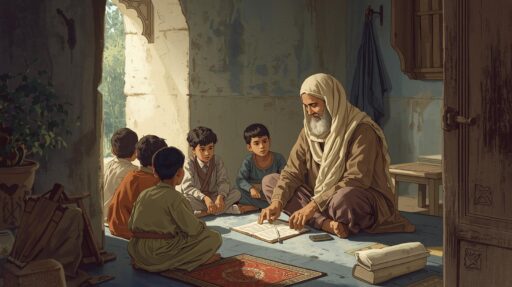
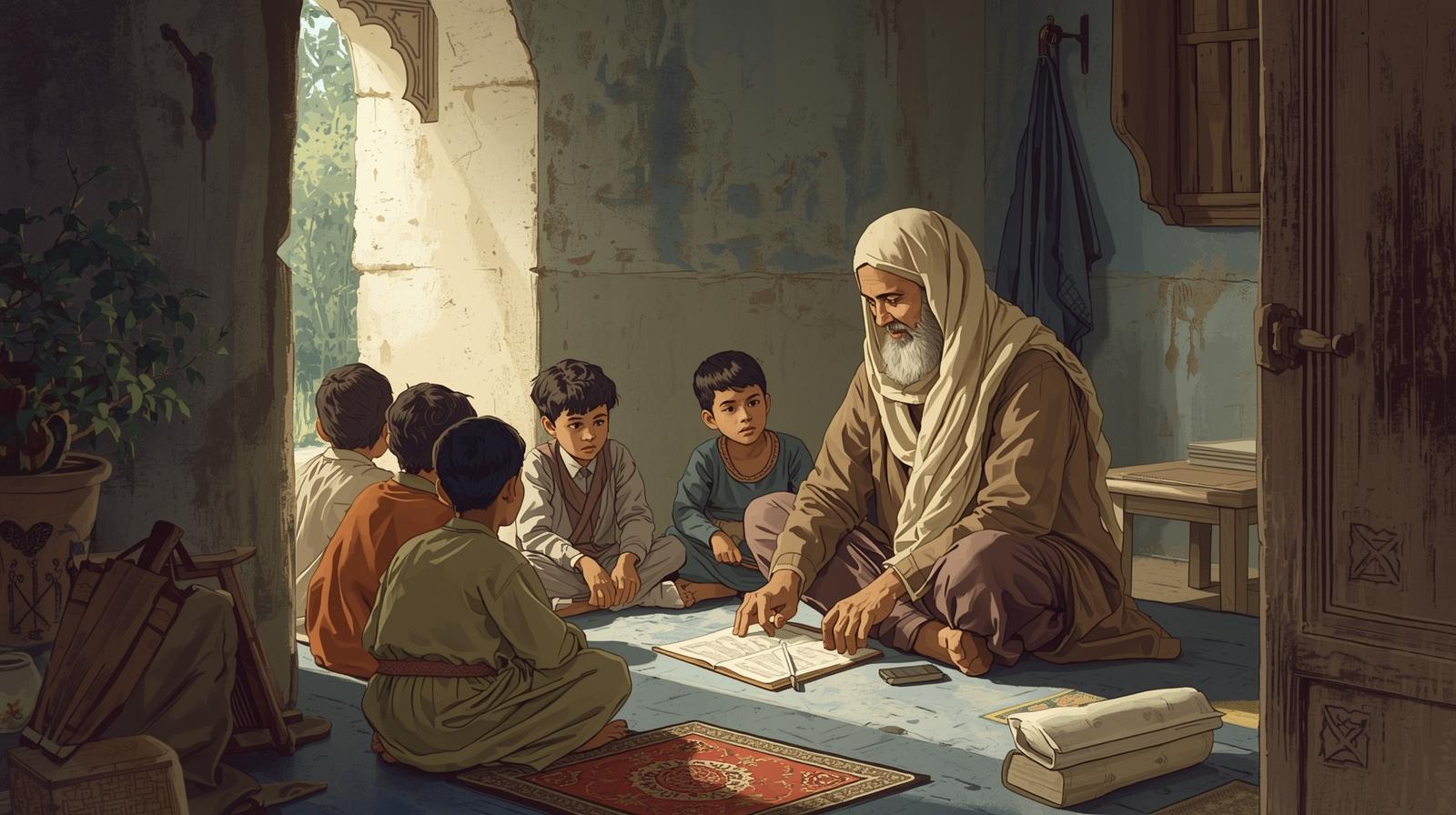
A Kuttab was not a purpose-built schoolhouse. It was typically a simple, bare room, often part of a mosque or a space provided by a wealthy patron. The central figure was the teacher, known as the Mutawa’ or Sheikh. This was not a professionally trained educator in the modern sense, but a respected man in the community known for his piety, his memorization of the Holy Quran (Hafiz), and his good character. His authority was absolute, and discipline was strict, reflecting the seriousness with which the community viewed the acquisition of religious knowledge. The Sheikh’s remuneration was not a fixed salary but a form of charity or community support, often paid in kind with food, dates, or small sums of money from the students’ families.
The Curriculum: Quran, Literacy, and Practical Mathematics
The curriculum of the Kuttab was singularly focused yet comprehensive in its aims. The primary, and often sole, textbook was the Holy Quran. The ultimate goal was for a child to Hifz—to memorize the entire Quran by heart—a feat that was, and remains, a source of immense pride for the child and their family. The process was rote and auditory. The Sheikh would recite a verse, and the children would chant it back in unison until it was committed to memory. Alongside this, students learned to write the Arabic alphabet on wooden slates (loh) using a reed pen and ink made from soot. Basic arithmetic, essential for trade and commerce, was also taught, focusing on practical skills like counting, addition, and subtraction.
A Rigorous Discipline: The Pedagogical Methods of the Past
The pedagogical approach of the Kuttab was starkly different from modern child-centered methods. Learning was a disciplined, often strenuous, endeavor. Corporal punishment, typically a light strike on the palm with a stick, was a common tool for correcting mistakes or a lack of focus. The environment was spartan, with students sitting on the floor in rows. There were no grades, no age-based classes, and no extracurricular activities. Progress was measured by the number of chapters (surahs) memorized. Despite its harshness by today’s standards, this system was effective in its context, instilling discipline, resilience, and a deep, lasting connection to the Islamic scripture.
The Social Role and Legacy of the Kuttab
The Kuttab was more than a school; it was a vital social equalizer. It was one of the few institutions accessible to both boys and girls, though they were almost always taught separately. For a few hours each day, children from different social strata—the sons of pearl merchants and the daughters of fishermen—sat together to learn the same sacred text. It was the primary vehicle for ensuring a baseline of religious and cultural knowledge across the community. While it did not produce engineers or doctors, it created a society that valued the written and spoken word, revered its religious texts, and understood the importance of disciplined study—values that would later smooth the transition to a modern, formal education system.
Conclusion: The Foundational Forge
The era of the Kuttab represents the first chapter in the UAE’s educational story. It was a system born of necessity, limited in scope, but boundless in its cultural and spiritual impact. It ensured that even in the most challenging of circumstances, the light of learning was never extinguished. The graduates of the Katatib became the first generation of parents in the oil era, already understanding the value of education, ready to send their own children to the new modern schools that would soon arise. The Kuttab was the foundational forge, and the knowledge it imparted became the bedrock upon which the modern, knowledge-based nation of the UAE would be built.